Lightning nodes on the rise - August 2021

The size of the Lightning Network continues to breach record levels but now at an even more rapid rate. Recent Lightning Network data has shown a large uptick in the number of Lightning nodes coming online and the capacity of Bitcoin held in Lightning channels. According to data from Bitcoin Visuals, the number of public nodes has grown by nearly two-thirds since mid-March. On March 16, there were 9,682 nodes. By August 15, there were 14,332 nodes1.
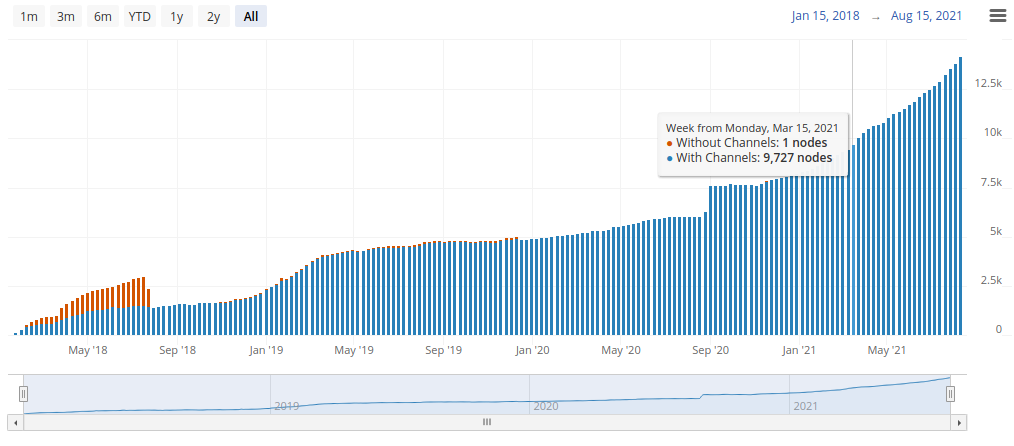
Lightning Network nodes for all time – with March 2021 values, https://bitcoinvisuals.com/ln-nodes
When we look at the number of Lightning channels, we see a similar trend. Lightning unique channels increased from 36,246 to 61,029 in the same period of time:
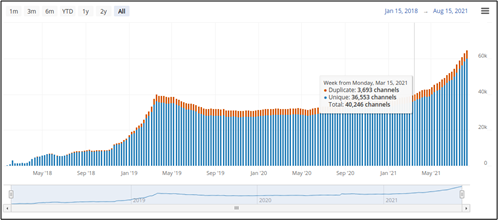
Lightning Network channels for all time – with March 2021 values, https://bitcoinvisuals.com/ln-channels
The growth in the number of nodes and channel creation has had a positive impact on the amount of Bitcoin these channels are carrying. It took almost three years for the network capacity to grow to 1000 BTC and remain above that level but now, August 16, 2021, the capacity is at 2,286 BTC2.
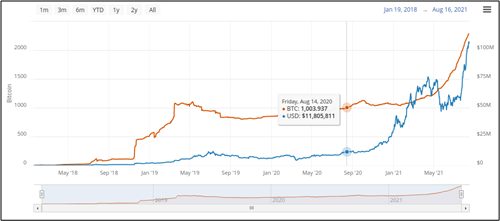
Lightning Network network capacity for all time – with August 2020 values, https://bitcoinvisuals.com/ln-capacity
So, the rate of node, channel creation and Bitcoin carrying capacity has been increasing.
Lightning nodes ensure trust in the Lightning Network. Each node opens up a payment channel funded by Bitcoin and then keeps a record of the true state of that payment channel. These Lightning nodes have the following responsibilities:
to monitor the changing state of Lightning channels in the Lightning Network,
to interact with other Lightning nodes to transact Bitcoin,
to keep track of who has what in each channel3.
There are several reasons behind this jump in the number of Lightning nodes. The Lightning Network has been the beneficiary of positive developments in the broader Bitcoin space such as the growing legal recognition of Bitcoin worldwide, the adoption of Bitcoin as a payment rail in which Lightning has been made available, the growing availability of DApps that use Lightning, and blockchain developers making it easier and quicker to set up a Lightning node.
Let’s unpack each of these factors.
Bitcoin’s legal acceptance
Leading into 2021, most countries had been allowing the use of Bitcoin as an alternative currency but with varying legal positions on it. Countries such as Estonia, Malta and the Seychelles allowed blockchain companies to operate under a friendly legal apparatus thereby giving Bitcoin a de facto legal acceptance. Established G20 countries such as Canada, the US and the UK have taken an ambivalent position: on the one hand, their regulators warn about bitcoin being a payment haven for terrorists and other undesirable groups and yet have allowed companies like Subway4, Amazon5 and Microsoft6 to accept Bitcoin payments (or hint at accepting them) in those same countries. President Nayib Bukele’s recent announcement about making Bitcoin legal tender in El Salvador was a formalization of this trend of legal acceptance. But, it still raised some eyebrows in the Bitcoin community just because the announcement was made without any warning or any prior to'ing-and-fro’ing with regulators.
Lightning in the Bitcoin payments
Part of the growing legal acceptance of Bitcoin is due to companies calling for it. And, following on from that, it is the presence of Lightning in various Bitcoin payment processors that has accelerated the use of Lightning as reflected in the numbers we discussed earlier. Payment processors such as BTCPay, BlueWallet, Globee, Strike and Bitcoin Beach offer wallet services with a Lightning facility which has made it easier for businesses to take advantage of Lightning as part of their Bitcoin adoption. An increasing number of these wallet services also guide users into setting up a Lightning node, such as OpenNode and Casa Node.
The combination of Bitcoin’s usage as a payment rail and its broader legal acceptance has paved the way for Lightning to become part of the payment infrastructure. Lightning operates at the backend with users not necessarily knowing that they are using Lightning. So, corporate adoption of Bitcoin has had a knock-on effect (a positive effect) on the increase of Lightning nodes, channels and Bitcoin-holding capacity.
A new kind of DApp
We will now turn to developments in the infrastructure of the Lightning Network itself. This is where users, wishing to help strengthen the network, have been linking with Lightning to run processes and to set up nodes.
There are more DApps, Decentralized Applications, coming online that use Lightning. Some examples are ZigZag, that uses Lightning for swapping between cryptocurrencies, and Bitrefill which offers Lightning-powered gift cards and bill payment facilities. The sheer expansion of DApps that run Lightning has given rise to the term LApps. While DApps refer to any crypto app that works with blockchains, LApps are designed to work specifically with the Lightning Network, especially in the areas of managing nodes and payment channels. This is a rapidly growing area of development for the Lightning Network and goes a part of the way of explaining why the number of nodes and channels have been rising.
Lightning Network services becoming more comprehensive
There are those users that are knowledgeable enough to wish to harness Lightning but may not have quite the technical level of expertise to run nodes, channels and watchtowers alone or from scratch. So, we are seeing the emergence of new platforms that run a whole suite of Lightning services that will attract new users of Lightning who wish to help build the network. Services like Blockstream’s Greenlight and Lightning Labs’s Lightning Pool offer users the opportunity to run a non-custodial Lightning wallet, use the platforms' resources to set up channels, develop DApps (or LApps), participate in a digital marketplace for Lightning channels, receive revenue for routing payments through multiple channels, run upgrades, run watchtowers, and share Lightning nodes on the Cloud with other users.
These are just some of the existing features that users of Lightning now have access. But, like the Bitcoin blockchain itself, Lightning continues to evolve, new features are coming through that are designed to make the Lightning Network more flexible and encourage greater network traffic.
New services incoming
Bitcoin is continuously evolving and the Lightning Network is no different. One such innovation coming from Blockstream, working on Lightning implementations, will make Lightning even more convenient to use. In May 2021, Blockstream utilised its c-lightning implementation to make it possible for both parties in a channel to deposit Bitcoin regardless of which party’s node had set up the channel. Dual funding of a Lightning channel means that the party with the Lightning node no longer has to bear all the fees and costs of opening the channel, of sending Bitcoin funds to the channel and then of closing the channel. With dual funding, any party can load the channel thus balancing the fee load and making the channel more efficient and much less prone to delays caused by unbalanced channels. Dual funding will also increase the capacity of Bitcoin held in the Lightning Network and will certainly encourage further creation of Lightning nodes and channels.
So, it is the combination of these developments that have smoothed the way for a great increase in the creation of Lightning nodes and, in turn, an increase in the amount of bitcoins deposited to the Lightning Network. These trends in turn strengthen both the case for financial decentralization and Lightning’s developing role as a low-cost gateway for future adoptions of Bitcoin.
------------------------------------------------------------------------------------------------------
Written for LQwD Fintech Corp in August 2021. The figures related to in this article were true at the time of writing. You can view the blog by visiting https://lqwdfintech.com/blog/
References
Bitcoin: Lightning Will Change How You Think About BTC - CoinDesk
Blockstream Rolls Out a Bitcoin Lightning Node for n00bs - CoinDesk
Bitcoin's Lightning Network Node Count Doubles in 3 Months - CoinDesk
The Lightning Network is Stronger than Ever
Greenlight by Blockstream: Lightning Made Easy
c-lightning Opens First Dual-Funded Mainnet Lightning Channel!
Blockstream Introduces Dual Funded LN-Channels
Current State of Lightning Network Privacy
[Lightning-dev] Proposal for rendez-vous routing
https://bitcoinvisuals.com/ln-nodes. I would like to put this into a broader historical context so you can visualize the gathering pace of node creation. Following the Lightning Network’s inception in January 2018, it took two years to reach the 5000 nodes benchmark, but then it took just 14 months to go from 5000 to 10,000 nodes (Jan 27, 2020 to March 22, 2021). And going by the current number of nodes, we may well reach 15,000 nodes by the end of September this year. So, 0-5000 in 24 months, 5000-10,000 in 14 months, 10,000-15,000 in 6 months.
Counting from Lightning’s inception in January 2018. https://bitcoinvisuals.com/ln-capacity
Suredbits, “Lightning 101: What is a Lightning Node?", December 19, 2018, https://medium.com/suredbits/lightning-101-what-is-a-lightning-node-af88e3183c40
NOWpayments.io, Subway: Bitcoin Accepted!, March 17, 2021, https://nowpayments.io/blog/subway-bitcoin-accepted
BBC News, Amazon Bitcoin job ad boosts cryptocurrency surge, July 26, 2021, https://www.bbc.com/news/technology-57971451
BBC News, Microsoft to accept payments made in bitcoins, December 11, 2014, https://www.bbc.com/news/technology-30377654